Optical illusions are captivating visual phenomena that challenge our perception of reality. These mind-bending images and tricks can leave us baffled, intrigued, and questioning the reliability of our own senses. In this article, we will delve into the science behind eight mind-blowing optical illusions, unraveling the secrets behind these fascinating visual puzzles.
Mind-Blowing Optical Illusions:
1. The Ames Room Illusion
The Ames Room is a classic optical illusion that distorts our perception of depth and size. When viewed from a specific angle, the room appears to be a perfect rectangular shape. However, the room is constructed with irregular dimensions, making one corner closer to the viewer than the other. This clever manipulation of perspective tricks our brains into perceiving the room as a uniform shape, challenging our understanding of spatial relationships.
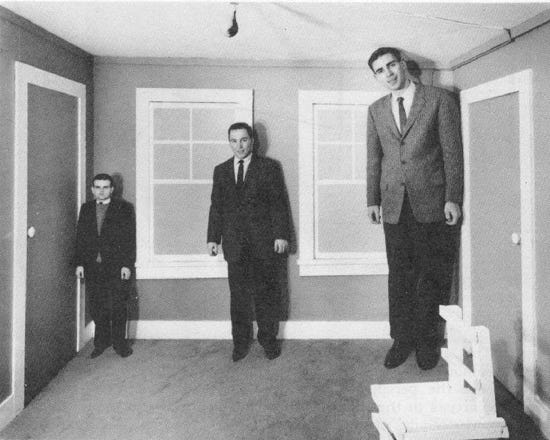
Explanation: The illusion relies on the viewer’s monocular depth cues, such as relative size and linear perspective. Our brain attempts to make sense of the room’s distorted dimensions, leading to the illusion of a perfectly rectangular space.
2. The Ponzo Illusion
The Ponzo Illusion demonstrates how our brain uses contextual cues to judge an object’s size. In this illusion, two identical horizontal lines are drawn across converging diagonal lines resembling railway tracks. The upper line appears longer than the lower one, even though they are the same length.
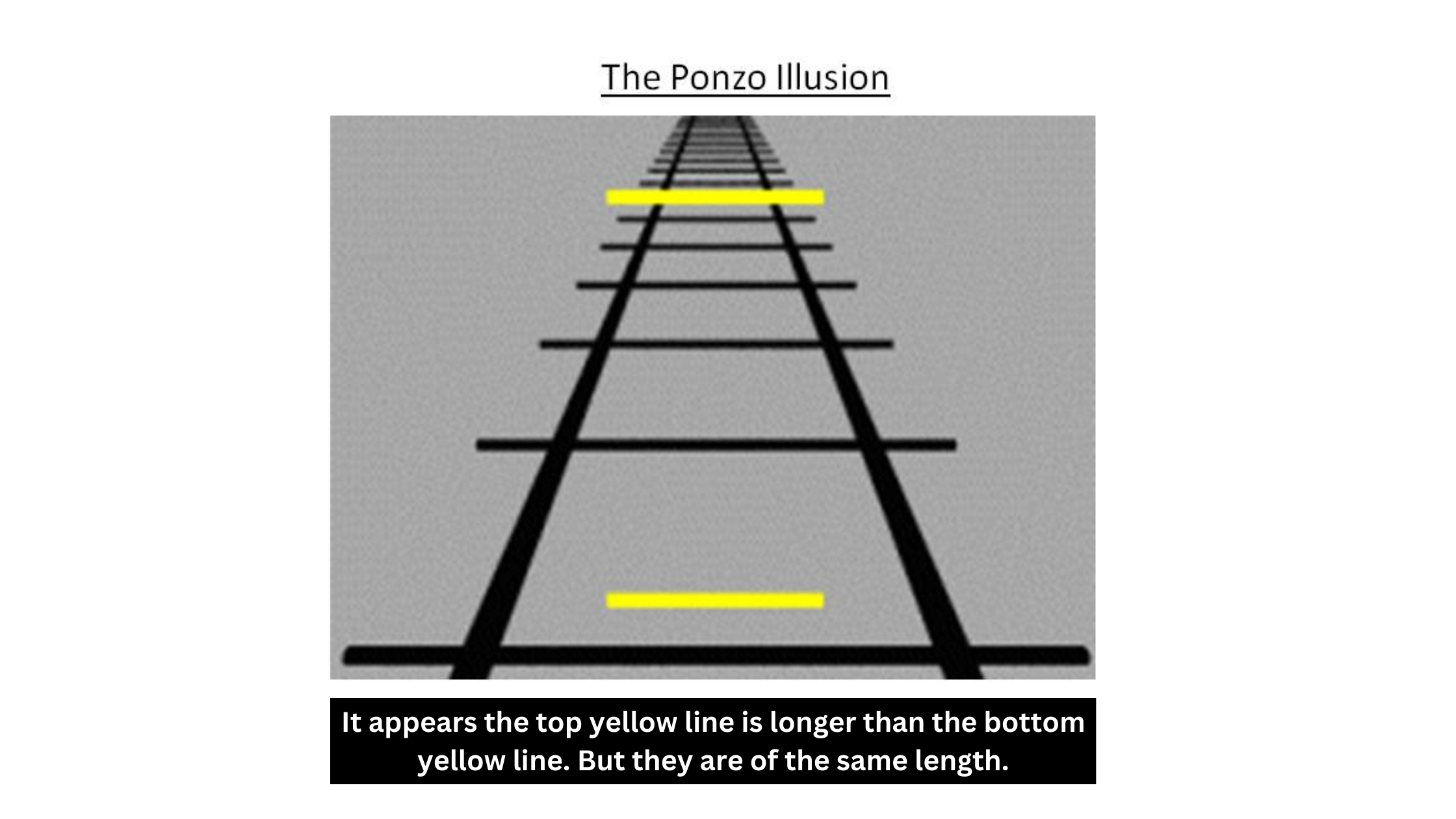
Explanation: Our brain interprets the upper line as farther away due to the converging lines, causing it to appear larger to compensate for the perceived distance.
3. The Kanizsa Triangle
The Kanizsa Triangle is a classic example of a subjective or illusory contour. When three “Pac-Man” shapes are arranged in such a way that they form an incomplete triangle, our brain effortlessly fills in the missing information, creating the illusion of a white, equilateral triangle.
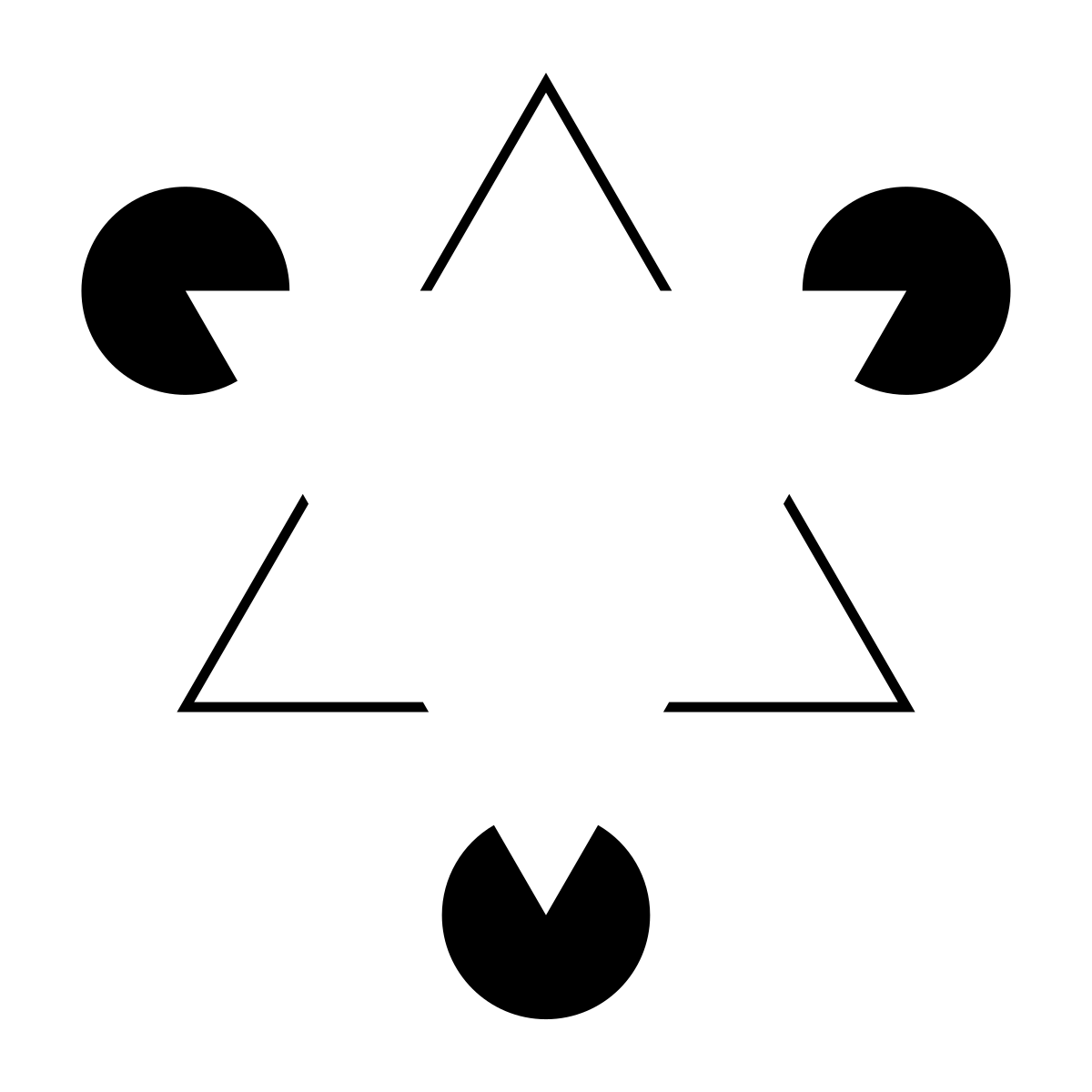
Explanation: Our visual system seeks to complete incomplete shapes, relying on the principle of closure. When the Pac-Man shapes align to form a triangle, our brain interprets it as a whole, even though the actual lines do not connect.
4. The Müller-Lyer Illusion
The Müller-Lyer Illusion plays with our perception of line lengths. Two lines of equal length are presented with arrow-like tails pointing inward or outward. The line with outward-pointing tails appears longer than the one with inward-pointing tails.
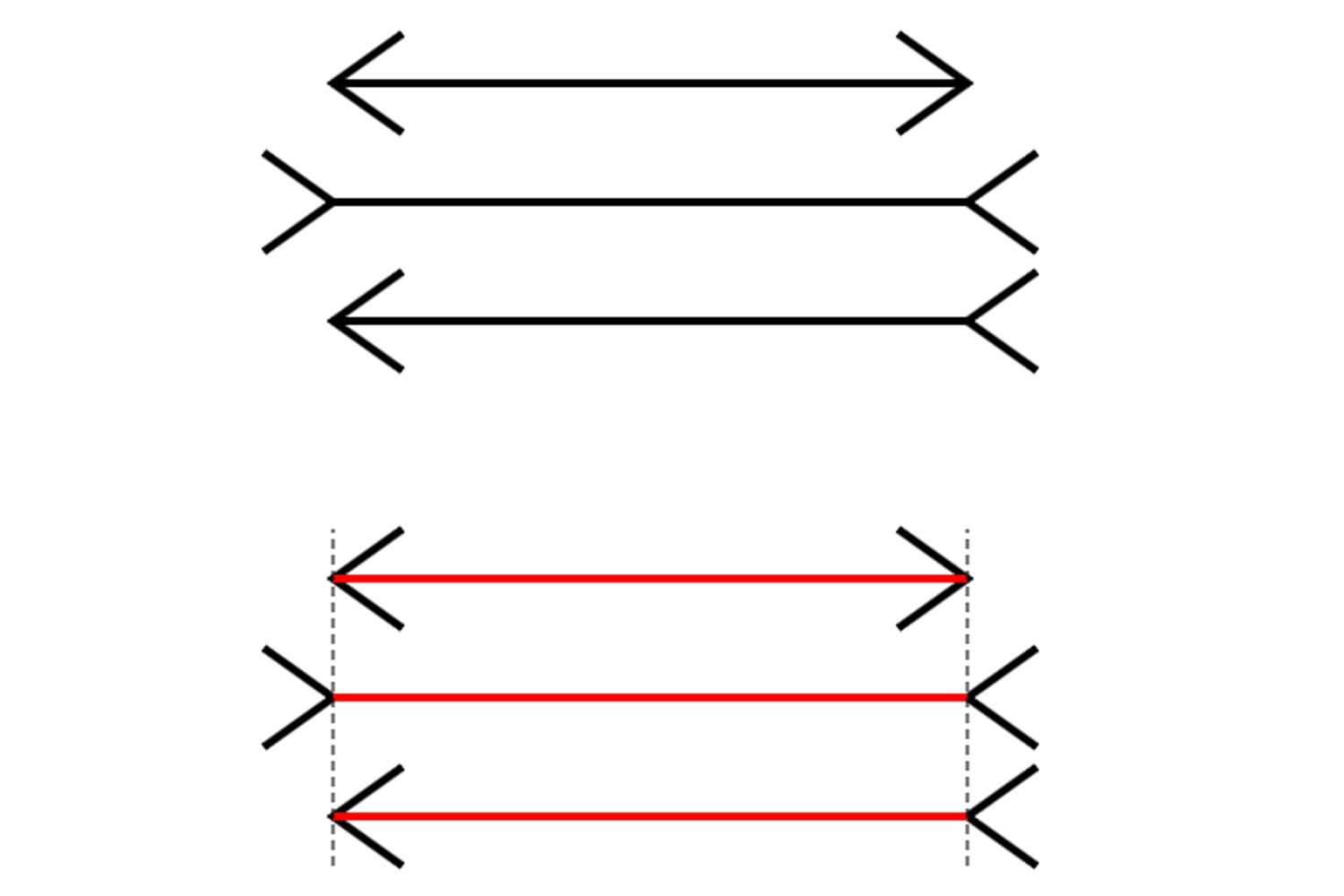
Explanation: This illusion is attributed to our brain’s interpretation of the arrowheads as depth cues. Outward-pointing tails mimic receding lines, making the line they cap appear longer, while inward-pointing tails mimic approaching lines, making the line they cap appear shorter.
5. The Rotating Snake Illusion
The Rotating Snake Illusion is an animated illusion that creates the sensation of continuous rotation in static images. When you focus on a specific area of the image, it seems like the snakes are continuously moving.
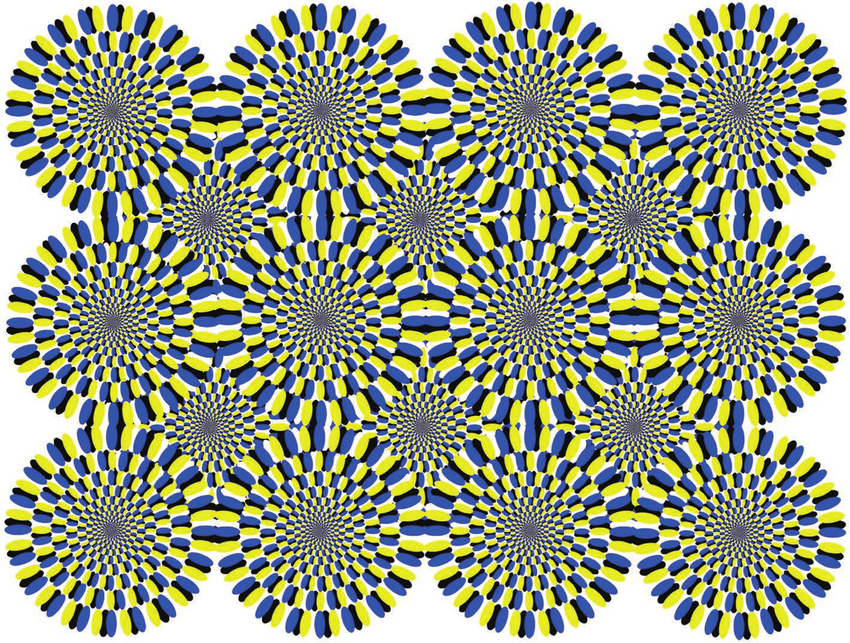


Explanation: This illusion exploits the way our eyes scan images. The high contrast and intricate patterns cause our peripheral vision to detect movement, even though the image remains static. As a result, the snakes appear to rotate.
6. The Hermann Grid Illusion
The Hermann Grid Illusion is a black-and-white grid with dark spots at the intersections of the lines. When you fixate your gaze on a particular intersection, the dark spots in your peripheral vision appear to disappear momentarily.

Explanation: This illusion occurs due to lateral inhibition in our visual system. When light receptors in our retina detect a bright spot, they inhibit the activity of neighboring receptors. This inhibition creates the perception of a dark spot’s disappearance.
7. The Motion Aftereffect (MAE)
The Motion Aftereffect is a phenomenon where prolonged exposure to a moving stimulus causes stationary objects to appear to move in the opposite direction afterward. For example, after staring at a waterfall, you might perceive nearby rocks as moving upward.
Explanation: The MAE is attributed to the adaptation of motion-sensitive neurons in the brain. These neurons become less responsive to the sustained motion, leading to a perception of motion in the opposite direction when viewing stationary objects.
8. The Rubin’s Vase Illusion
Rubin’s Vase Illusion is an ambiguous figure that can be interpreted as either a vase in the center or two facing profiles on either side. Depending on how your brain chooses to interpret the image, you may switch between perceiving the vase or the profiles.

Explanation: This illusion demonstrates the principle of figure-ground organization. Our brain alternates between interpreting the white or black regions as the “figure,” leading to the two possible perceptions.
Conclusion
Optical illusions are a testament to the complexity of human perception. These mind-blowing visual phenomena reveal how our brains interpret and process visual information, often leading us to perceive the world in ways that challenge our understanding of reality. While these explanations shed light on the science behind these optical illusions, they continue to captivate and mystify us, reminding us of the intricate and fascinating workings of the human mind.
Also Checkout – 7 Indian Scientific Breakthroughs That Changed the World