

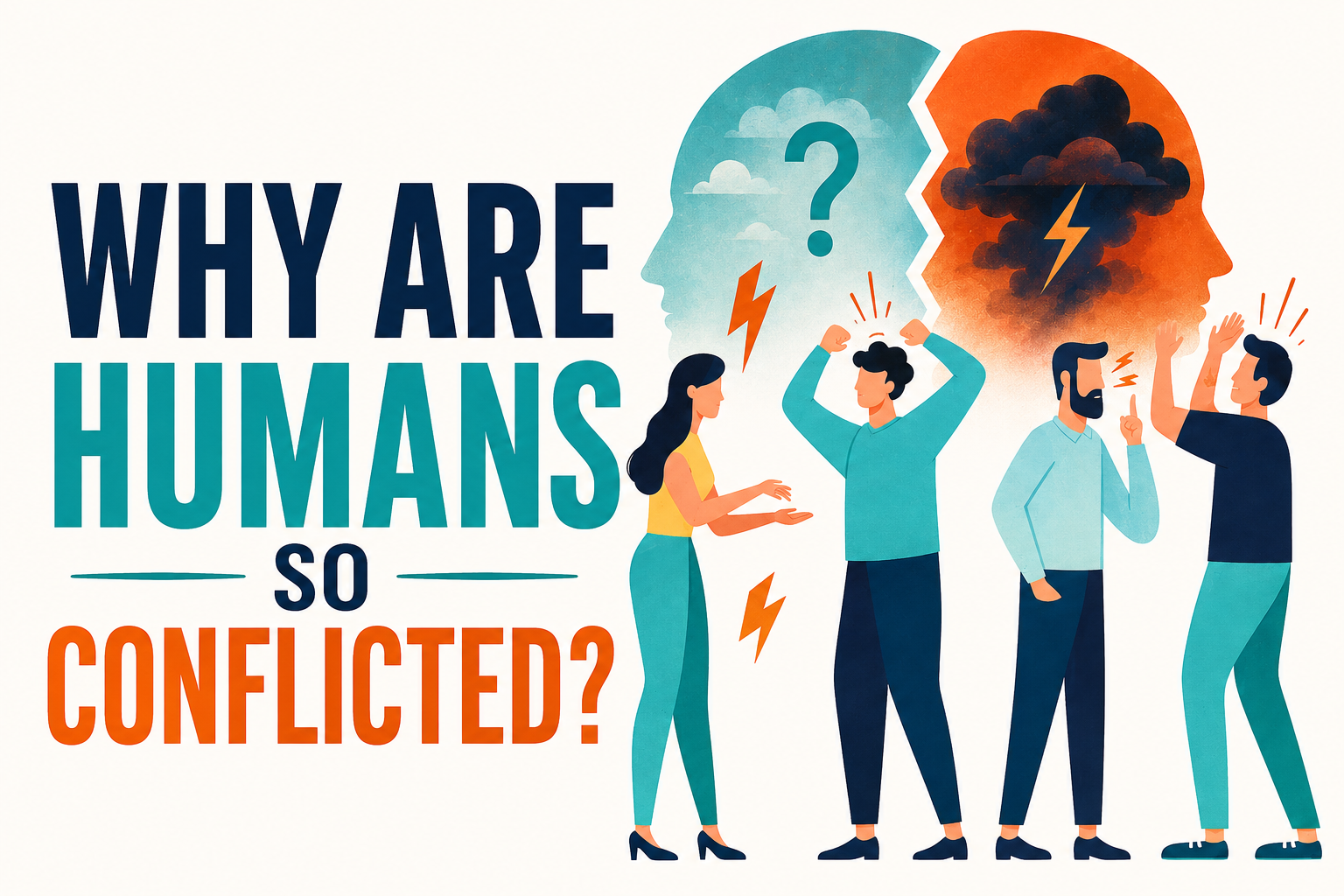
For thousands of years, people have tried to answer one of humanity’s oldest questions: why do human beings possess extraordinary intelligence, creativity and compassion, yet also display anger, conflict, selfishness and war?
Religions, philosophers, psychologists and scientists have all offered different explanations. Some see the problem as moral, others as evolutionary, cultural or psychological. While no single theory has gained universal acceptance, exploring these different perspectives provides insight into how various thinkers have attempted to understand what is often called the human condition.
Viktor Frankl: The Search for Meaning
Psychiatrist Viktor Frankl believed many psychological struggles arise when people lose a sense of meaning and purpose. Having survived Nazi concentration camps, Frankl argued that humans can endure extraordinary hardship if they can find meaning in their lives.
His approach, known as logotherapy, proposes that fulfilment comes not from pleasure or power but from discovering purpose through work, relationships and the attitude we adopt toward suffering. Frankl’s ideas continue to influence psychology, counselling and personal development because they focus on helping people orient themselves toward meaningful lives.
Carl Jung: Reconciling the Shadow
Swiss psychiatrist Carl Jung suggested that much of human conflict originates within ourselves. According to Jung, every person possesses a “shadow”—those aspects of personality we reject or suppress because they conflict with our conscious self-image.
Jung argued that psychological growth requires acknowledging and integrating these hidden aspects rather than denying them. Many modern therapeutic approaches continue to draw upon Jung’s concepts of individuation, archetypes and the unconscious mind as ways of understanding why people often struggle with contradictory thoughts and emotions.
Ernest Becker: Living with the Awareness of Death
Anthropologist Ernest Becker approached the human condition from another angle. In The Denial of Death, he argued that much of human behaviour is shaped by our awareness of mortality. Unlike other animals, humans understand that life will eventually end, creating profound existential anxiety.
Becker suggested that cultures, belief systems and personal achievements often serve as ways of managing this anxiety by giving individuals a sense that their lives have enduring significance. His work later influenced Terror Management Theory, which examines how awareness of death affects decision-making, identity and social behaviour.
Jeremy Griffith: A Biological Explanation of the Human Condition
Australian biologist Jeremy Griffith offers a different perspective, arguing that the human condition has a biological origin rather than primarily a cultural or existential one.
Griffith proposes that the defining conflict in human life emerged when our ancestors developed fully conscious minds. While instincts—acquired through genetic selection over countless generations—could orientate behaviour, consciousness brought an entirely new requirement: the ability to understand, question and experiment independently. According to Griffith, this unavoidable tension between instinctive orientations and the conscious mind’s search for understanding created a psychological conflict that has shaped human behaviour ever since.
In Griffith’s interpretation, the instinctive self effectively criticised the conscious mind’s necessary experiments in self-management because instincts could not understand why those departures from instinctive behaviour were essential. This internal conflict, he argues, gave rise to the defensive behaviours associated with the human condition, including anger, egocentricity and alienation.
His broader work extends this explanation into many areas, including human evolution, cooperation, consciousness, mythology and religion. Among other claims, Griffith argues that his explanation accounts for how humans became fully conscious while other animals did not, and that understanding this conflict ultimately removes the need for humanity’s long-developed psychological defences.
RELATED STORIES

For readers interested in exploring Griffith’s ideas further, several independent discussions provide different perspectives on his work, including one reader’s assessment of Who Is Jeremy Griffith? My Conclusions Thus Far, a detailed book review of FREEDOM, and a personal reflection on Jeremy Griffith’s interview and explanation of the human condition.
Different Paths Toward the Same Question
Although these thinkers arrive at different conclusions, they share a common goal: understanding why human beings so often struggle despite possessing remarkable intelligence and potential.
Frankl emphasised the importance of meaning. Jung focused on integrating the unconscious mind. Becker highlighted humanity’s awareness of mortality. Griffith proposes a biological explanation centred on the emergence of consciousness and the resulting conflict between instinct and intellect.
Whether one finds any particular explanation convincing, together these approaches illustrate the enduring effort to understand ourselves. The persistence of this question across philosophy, psychology, biology and anthropology suggests that understanding the human condition remains one of humanity’s most important intellectual challenges.